
The idea of “product integration” was a running gag in NBC’s “30 Rock.” But for NBCUniversal, the topic is no joke, executives say.
NBCU has spent the last seven years developing shoppable television across its own platforms, like Peacock, as well as third-party platforms, like LG TVs. Now, viewers can buy products from about 12 of their favorite shows, like the traitors’ cape from “Traitors” or the monogrammed water bottle from “Love Island USA.” Sometimes, this content shows up as an in-ad QR code that viewers can scan with their phone; other times, it pops up on screen during a scene of a show like “Below Deck,” and viewers can scroll through products in that scene with their remote.
NBCU is now seeing that its business from shoppable TV is growing “significantly year over year,” said Evan Moore, svp of commerce partnerships at NBCU Advertising & Partnerships. Moore said that this content is sparking a 171% increase in brand favorability, when attached to IP that viewers care about. Engagement is also 3X higher when there’s an in-show product integration, versus an ad.
Moore spoke with Modern Retail at Shoptalk Fall to share more about how NBCU views the future of shoppable TV. The following interview has been edited for length and clarity.
What does NBCU’s shoppable TV model look like, on the brand side?
“What’s fun is we have a lot of different points of entry for brands to come into our shoppable television ecosystem. Oftentimes, it becomes an extension of a traditional product integration sponsorship model, where they’re integrating their product into a show like ‘Love Island’ or ‘Top Chef,’ and then we’re using our tactics and technology to extend that into a shoppable experience when consumers watch it.
Other times, we built our own third-party seller marketplace. … Brands of any size can join the marketplace and bring their products into the ecosystem for free. They can join [our program] and expose their products to our team, and then we will use our technology to identify moments across our programming that make sense to present those products to consumers to shop.
We also work with them in different ways, too. They might do something like a trade-out, which is basically where a brand agrees to provide the production [team] with free product, with no guarantee about what’s going to happen to the product. It’s somewhere in between a product integration and organically having your product in our marketplace. … If it gets featured in the show, then we make that experience shoppable.”
What does it mean to integrate a third-party product with shoppable TV?
“We will take an episode of a show, and we’ll scan that episode using a computer-vision partner that we work with, where the model has been trained on our catalog of products that we have on our marketplace. The output will be products that have been identified as either exact or similar matches [to items] within different scenes of the show. Then, our human operators will review those matches and sometimes edit them. [They may say] ‘That roll of duct tape doesn’t need to be shoppable in this scene.’ Or, they may augment it and say, ‘The computer vision didn’t catch this shirt that we … have in the marketplace.’ Or, ‘We should also suggest these additional products.’
After we do that, we create collections around different shoppable moments within a show. And we present those collections, either within our own web-based shopping experience that we drive users to when they’re watching the show, or we expose it via APIs to partners like LG, so that they can create on-screen, interactive shoppable moments through their television operating system.”
Are you finding that people are interested in buying products they see on TV?
“Yes. We’ve been doing [shoppable TV] for seven years now, and we started with just a couple of shows. Now, we do this across about 12 different shows within our portfolio. What we’ve found is that the driver of success is relating shoppable experiences to our IP. … When we associate shoppable moments to the IP that fans care about, they engage [with it] at a significantly higher level, both in terms of initial engagement and actual shopping behavior. And also, the brand sentiment, favorability [and] recall — all those things go up when we can refer to or relate to a brand.
Second, when we bring that shopping experience [out] from within the ad experience — actually [putting it] in the show — we see an even greater response from the consumer. … And then, finally, the easier we can make it for the consumer to go from what they’re seeing on screen to being able to shop the products they want, the higher the engagement. That actually got us investing more in remote interactivity on screen.”
If somebody’s watching a show and they decide, ‘I want to buy this sweatshirt,’ are they still able to watch the show while they buy it?
“Yes. With the LG experience, the whole show squeezes back. It continues to play, and you’re interacting on the sidebar. And that’s an important point: We have discovered that we need to offer consumers optionality for how they engage with the shopping experience. Even if we get to the point where we can drive the entire transaction on screen, that’s not always going to be appropriate. You might be watching a show with your whole family, and your whole family is not going to want to sit there and watch you shop. We need to both enable the shopping experience on screen for those that want to engage with it, and then also give [viewers] the ability to take it to a second screen [like their phone], or save it for later.”
You said you’re doing shoppable TV across roughly 12 shows. Do they have anything in common?
“We’ve worked a lot within unscripted, to date, which tends to align really well with aspirational shopping and fashion and home goods and the categories that we tend to emphasize. We’ve done some experimentation in scripted, and had really positive results. And we’re excited about some of the original content we’re creating, like ‘Shop What Happens Live.’ … That was our first foray into original shoppable programming that was underwritten with our partner Target. … We’ve also done some shoppable Bravo after-shows that have performed really well.”
Are any of the products you are offering exclusive to these shows?
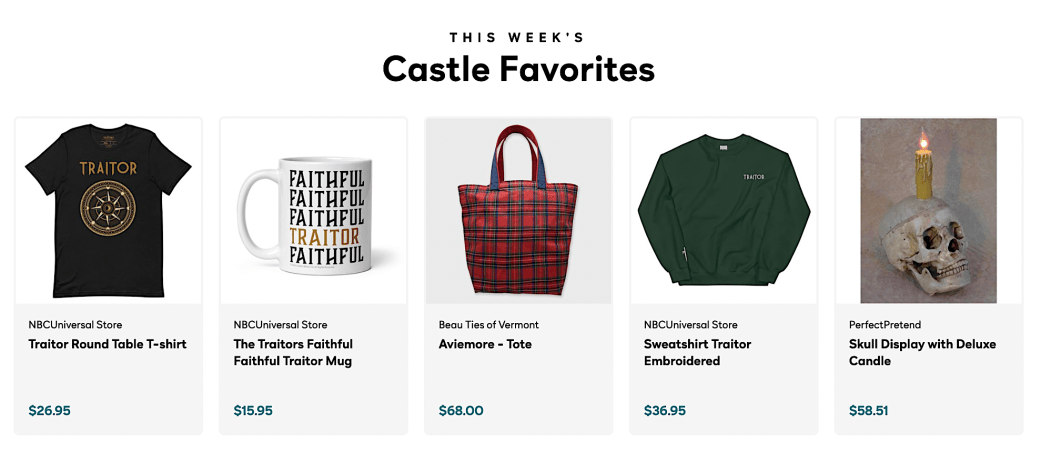
“A lot of the products that we offer are our own licensed merchandise, to go along with the organically-identified products within the show. Sometimes, that merchandise might be the actual water bottle with your monogrammed name on it from ‘Love Island.’ … With ‘Traitors,’ we do episode-inspired merchandise. So, if there’s a cool line or viral moment that happens in an episode one week, we’ll have a shirt or hat or mug that relates to that moment the next week. We see huge levels of response to that. That’s a really exciting area for us to explore: How can we create products that help consumers identify and show their fandom?”
How is this segment of your business performing, overall? And how do you view its future?
“We’ve seen increasing interest in shoppable integrations into shows and also shoppable media products and sponsorships year over year. The business has grown significantly year over year, and we’re only seeing more demand and opportunity, especially as it relates to the growth of retail media. Retail media continues to grow as an overall industry, and so much of that spend is starting to make its way into television, which brings a lot of really exciting opportunities for us. How can we leverage retail-media-style tactics across a shoppable television experience at scale? [That] is an area that we’re exploring pretty heavily.”