
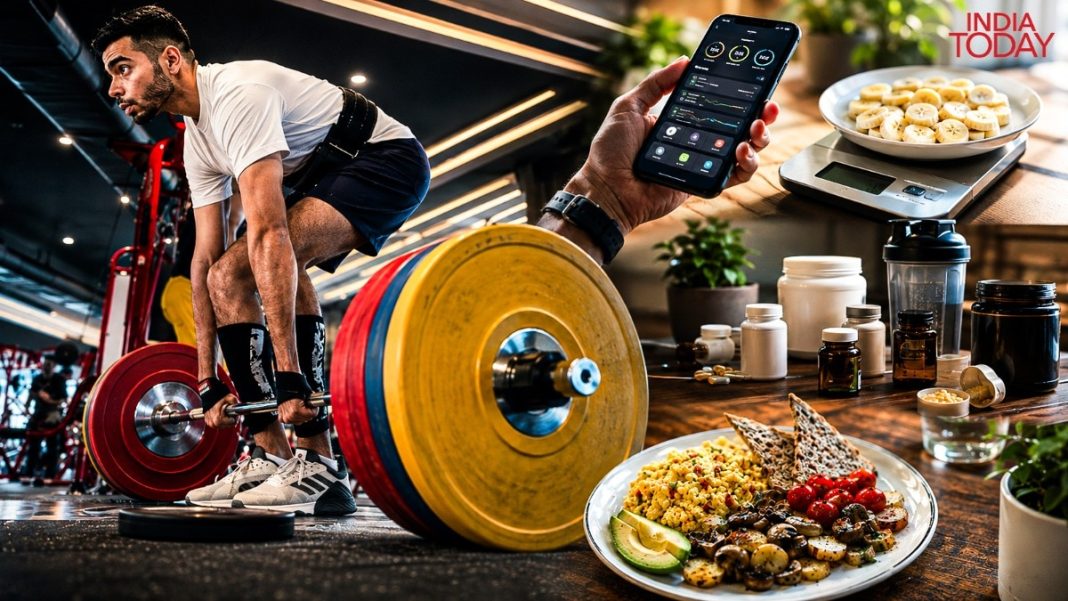

For most people, health exists in vague promises: a Monday gym plan, a step-count reminder ignored by evening, a late-night promise to “start fresh tomorrow”. Some are more disciplined, hitting the gym regularly, watching their diet and trying to stay on top of their wellbeing.
But a growing number of urban Indians are taking fitness several steps further. For them, health is no longer an activity squeezed between work and social life. It has become a carefully designed system built around sleep scores, recovery metrics, calorie tracking, wearables and structured routines. Their days revolve around smart rings, sleep trackers, macro counts, resting heart rates and step goals.
Some stand through office meetings just to complete their ‘standing-hour targets’. Some refuse to take elevators for anything under six floors.
Of course, there is another side to this hyper-quantified lifestyle too. When the numbers start running you instead of you using them, several things can go sideways: anxiety, disordered behaviour, worse sleep, overtraining and a strange disconnection from your body’s own signals. For some, constantly analysing recovery scores or sleep data becomes stressful in itself.
And yet, for many others, the structure works. The tracking becomes less about obsession and more about awareness, accountability and feeling better in everyday life. You may call them health nerds. They probably would not disagree.
From entrepreneurs and content creators to tech professionals and editors, we spoke to people whose lives are quietly shaped by metrics most of us never think about. Here is a glimpse into their hyper-disciplined worlds.
Yash Sharma
A life measured in recovery
For Yash Sharma, a 31-year-old fitness content creator and entrepreneur, every morning begins with a number.
Before checking messages or getting out of bed, he straps on his Apple Watch and checks his resting heart rate, a metric he treats almost like a daily health report card.
Resting heart rate (RHR) is the number of times your heart beats per minute when your body is completely at rest, usually measured right after waking up. It is often used as a broad indicator of cardiovascular fitness, recovery, stress and overall health. For many fitness enthusiasts, it acts like a “readiness score” for the body. A lower resting heart rate often suggests better cardiovascular efficiency and recovery. A higher-than-usual resting heart rate, on the contrary, signals stress, poor sleep, dehydration, illness, overtraining, alcohol intake or fatigue.
Anything around or below 60 feels like reassurance that his body is recovering well. Heavy workouts and intense training demand proper rest, after all.
Earlier, he would also wear his Apple Watch through the night to track and analyse his sleep patterns, but over time, he realised that RHR mattered far more to him as a marker of recovery and overall health.
The rest of the day follows the same precision. Meals are rarely intuitive; they are measured. Even if he is heading to a family function or a party, he is likely to carry a lunch box packed with a quantified meal.
Very recently, Sharma attended his cousin’s roka on a Sunday afternoon and had to participate in a hybrid race later that evening. While everyone else dug into aloo-puris, mithai and paneer masala, he quietly finished the grilled chicken and rice meal box he had carried from home.
You will not see him having coffee or even Coke in the evening because it disrupts sleep and, consequently, recovery.
So, stimulants are tightly controlled. No caffeine, Coke or pre-workout drinks after 6 pm, no matter how long the day has been. Even dinner follows a schedule built around recovery. He tries to finish eating at least four hours before going to bed because, for him, good sleep is not accidental, it is engineered.
Akshay Soni
Inside a life tracked by apps
A look at Akshay Soni’s phone tells you fitness is a way of life for him. There is the Coros app tracking sleep and recovery, Strava for runs, Strong for workout logs and MyFitnessPal converting meals into calories and macros.
For the Mumbai-based techie, fitness is not an activity squeezed around work. It shapes how he moves through the day.
His mornings begin with sleep data. Soni wears a Coros watch to sleep, tracking metrics like deep sleep, REM sleep, recovery and stress levels. The most important number, he says, is HRV, or heart rate variability, which tells him how well his body has recovered.
“If recovery is bad, or if it was a late night, you already know the day will feel different,” he told India Today Digital. “Brain fog becomes extremely high for me.”
He said it like someone who has spent enough years observing his body to trust patterns over motivation. If it is a running day, the watch comes along. Earlier, he says, he would simply run and log distance on Strava.
Now he knows exactly what heart rate zone he is training in, whether he started too fast, whether his pace dropped midway through a 10K. The numbers are not vanity. They are feedback loops. “To improve performance, you have to tweak variables,” he said.
Gym days are different. There is an online coach involved now, which means accountability enters the picture. Every Sunday, he sends check-ins: progress photos, daily weight logs, step counts and cardio updates. Inside the gym, the Strong app becomes his discipline archive. How much weight did he lift last week? How many reps? Can he add one more today?
Outside the gym, the tracking continues quietly through meals. At home, food is measured on a weighing scale. Smoothie bowls, avocado toast and rice portions are quantified and entered into MyFitnessPal. Eating out requires approximation: pizza slices, pasta servings and Subway sandwiches selected from the app’s database. Not perfect, but close enough.
His coach sets the macros depending on the goal. Fat loss means a certain protein target, controlled carbs and regulated fats. The app merely becomes the ledger.
None of this sounds obsessive when he explains it. It sounds practical. Almost calm.
There are smaller habits too, the kind fitness people develop unconsciously over years. Walking for five minutes after meals, choosing to walk to a nearby cafe instead of driving and taking opportunities to increase step count wherever possible.
Every six months, he gets blood tests done. If something is deficient, supplements are adjusted. Sleep is monitored. Recovery is monitored. Food is monitored. Workouts are monitored. Even mood, indirectly, becomes measurable through performance dips and recovery scores.
Yet beneath all the data, the reason remains surprisingly human. “You feel much better doing it than not doing it,” he told us. Because ultimately, fitness for him is not about six-packs or athletic achievement alone. It is about energy, confidence, mental clarity and the sense of momentum that spills into work and life.
Yatharth
The Whoop band never leaves his wrist
The Whoop band, the screenless wearable popularised by athletes including Virat Kohli and Cristiano Ronaldo, rarely leaves Yatharth’s wrist. For the Delhi-based fitness influencer and competitive bodybuilder, the 30,000 device has become less a gadget and more a quiet observer of his life, tracking how well he sleeps, recovers and prepares for the next day. Inspired by anti-ageing influencer Bryan Johnson, Yatharth bought the wearable not to count steps or check notifications, but to decode recovery itself.
His mornings unfold with near-mechanical consistency. There is no fixed wake-up time, but the ritual never changes: warm water, coffee, a handwritten self-note, a few minutes in the sun and then 45 minutes to an hour on the treadmill. Meals are cooked at home, weighed carefully and planned in advance. “If it doesn’t go on the weighing scale, it doesn’t go into my stomach,” he told us. To save time, he batch-cooks meals for days at once, fitting content shoots and video edits between training sessions and meal timings.
But the real obsession lies in sleep. Every morning, Yatharth checks one metric closely: resting heart rate during sleep. Over months, he has experimented with habits to bring it down, especially eating dinner five hours before bed and keeping it light. “If I eat two hours before sleeping, it shoots up to 60,” he said. “Now it stays around 49.” To him, that number is proof that the body spent the night recovering instead of digesting.
Ritu Batra
Relearning food and fitness at 60
One morning, when Ritu Batra checked her fasting sugar levels, the number flashing on the screen left her stunned: 220. Further tests confirmed what she had feared. She had become diabetic. For someone who had once hovered in the pre-diabetic range, it was a wake-up call she could not ignore.
That moment marked the beginning of a complete lifestyle transformation. Determined to take control of her health, the 60-year-old joined a diabetes-management app called SugarFit, a decision she now credits with changing the way she understands food, fitness and her body altogether.
Today, her mornings begin with checking her fasting sugar levels and weight, rituals that quietly determine how disciplined she will be through the day. Her once-casual approach to food has been replaced with mindful eating habits, carefully planned meals and an almost scientific understanding of nutrition. She now casually throws around terms like ‘glycemic index’, ‘complex carbs’ and ‘meal sequencing’ in everyday conversation.
Once addicted to chai, she now relishes black tea without sugar and a protein-rich breakfast. Before every meal, she makes it a point to eat a salad first, followed by protein and then carbs, a sequencing method she says helps manage sugar spikes. On days when she wants to eat rice or potatoes, she ensures they are refrigerated overnight before consumption.
“This way, they turn into complex carbs and don’t lead to sharp sugar spikes,” she told us.
Even the flour she uses is different from the rest of the family’s, usually multigrain, jowar, ragi or khapli wheat. Her evening snack cravings are carefully managed with homemade seed-and-sattu laddoos or puffed-rice bhel packed with nuts and protein.
Technology plays a central role in her routine. She logs her sugar readings, weight and meals on the app, tracks her steps through a smartwatch and aims for nearly 10,000 steps a day alongside intermittent fasting and light strength exercises. At one point, she even used a continuous glucose monitoring device to understand how different foods affected her body in real time.
Far from approaching health as a burden, Batra has turned it into a passion project. She swaps recipes, experiments with herbal teas, researches ingredients and constantly fine-tunes her routine with the curiosity of someone decades younger.
At 60, she has not only reversed years of unhealthy habits but has also reinvented herself into someone deeply conscious and intentional about her wellbeing.
Panckaj Umrania
The entrepreneur who tracks his body like a business
Now, let us take you through a regular day in the life of Panckaj Umrania. He is a 42-year-old entrepreneur based in Gurugram. He tracks his body with the precision of someone managing a business dashboard: sleep quality, recovery scores, hydration levels, training intensity, daily step counts between 10,000 and 14,000 and nutrition measured through weighing scales and intake tracking. To an outsider, it can sound excessive. To him, it is simply maintenance.
On his finger sits a Gabit Smart Ring, quietly monitoring metrics like sleep, stress, recovery score and bio age, with all the data synced to an app he checks daily.
“I realised in my early 30s that performance in business and life is directly linked to physical energy, recovery and discipline,” he said.
His days begin before sunrise. Between 5 and 6 AM, while most of the city is still asleep or scrolling through alarms, Umrania is already hydrating and preparing for training. By 7 AM, he is in the gym for a one-hour workout, six days a week. His workday begins at 9:15 AM, but the health routine continues quietly in the background all day: measured high-protein meals, constant movement, hydration, step tracking and strict sleep timing. By 9 PM, he is usually in bed.
He speaks about sleep the way executives speak about investor meetings: non-negotiable.
Over 13 years, he says, he has learned that consistency matters far more than intensity. And the biggest shift came not from harder workouts, but from understanding recovery. While most people obsess over exercise, Umrania believes transformation happens elsewhere, in sleep quality, stress management and nutritional balance sustained over years.
“Once you start tracking metrics like sleep quality, calorie intake, macronutrient balance, VO2 max, RHR, HRV and recovery patterns, you begin to understand your body at a completely different level. Even the quality of your social circle and conversations starts carrying weight in your overall wellbeing and transformation. When all these factors come together, the game changes entirely,” he told India Today.
“People say nutrition is 70%,” he said. “I think nutrition is 50%, sleep is 40% and training is only 10%.”
That philosophy changes the way he moves through life. Fitness, for him, is no longer about aesthetics or temporary goals. It has become identity.
Shraddha Chowdhury
Beyond the obsession with metrics
As for Shraddha Chowdhury, Assistant Editor with Hello! Magazine, her approach to health is rooted in balance, awareness and sustainability rather than extremes. She does not fit the stereotype of a hardcore health geek constantly chasing the latest wellness trend or obsessively tracking every metric anymore, but she has clearly evolved into someone who has deeply integrated health into her everyday life.
At one point, she was an avid user of her Apple Watch, tracking calories burned, step counts, workout goals, standing reminders, sleep and even competing with friends over activity rings. The watch became a source of motivation and accountability, helping her build discipline and awareness around movement and fitness. She logged meals on apps like HealthifyMe, learned calorie values by memory, understood portion sizes and became conscious of how food, sleep and activity affected her body.
But what makes her interesting is that she eventually outgrew the dependence on those devices and metrics. She realised that whether she wore the watch or not, her habits remained the same. She still worked out regularly, walked after meals, stayed active despite having a desk job and naturally maintained the routines she had spent years building. That shift reflects someone who moved from external validation and tracking to internal awareness and consistency. She consciously stepped away from the watch because she felt the tracking itself was becoming an unhealthy obsession, and she did not want another screen controlling her life.
Today, she prioritises getting around seven hours of sleep because she understands how her body functions best. She strength trains, walks daily, includes protein in every meal despite being vegetarian, takes supplements relevant to her needs like B12, omega supplements and magnesium glycinate and focuses on balance instead of restriction.
Over more than a decade, she seems to have transformed health from a temporary fitness phase into a permanent lifestyle, where wellness is no longer something she tracks obsessively, but simply the way she lives.
Call it optimisation, call it discipline, or simply call it the new urban lifestyle. For these health enthusiasts, the tracking never really stops.
– Ends