
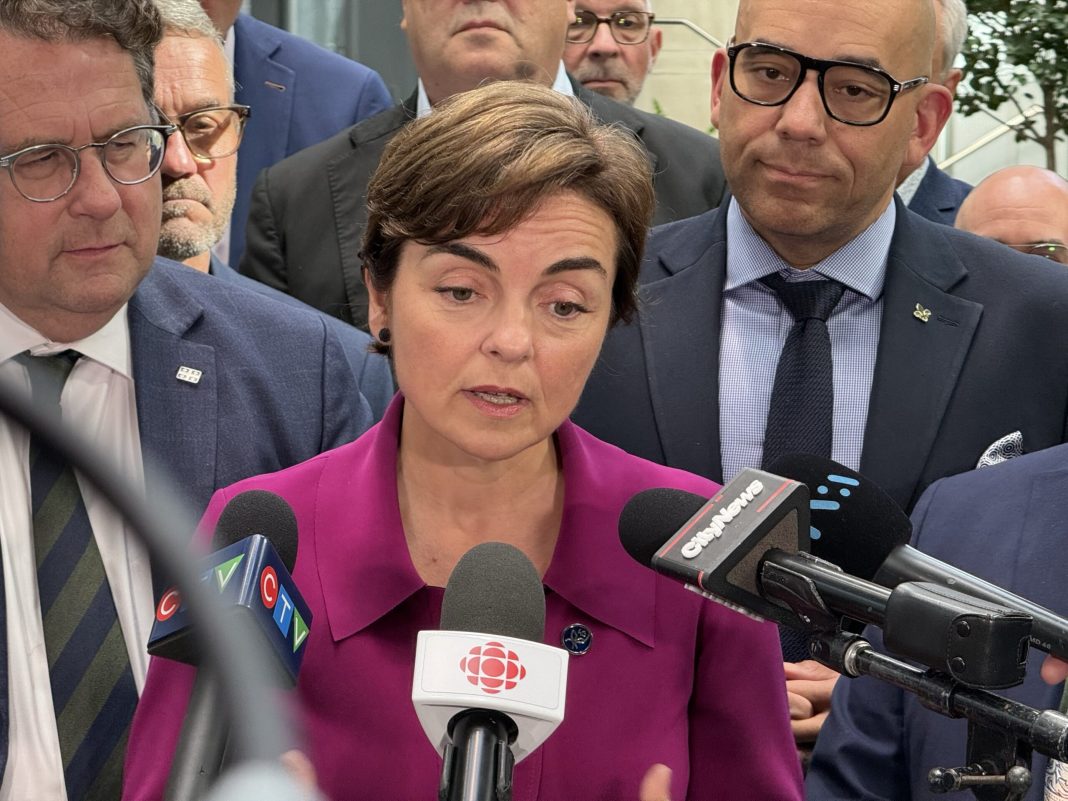

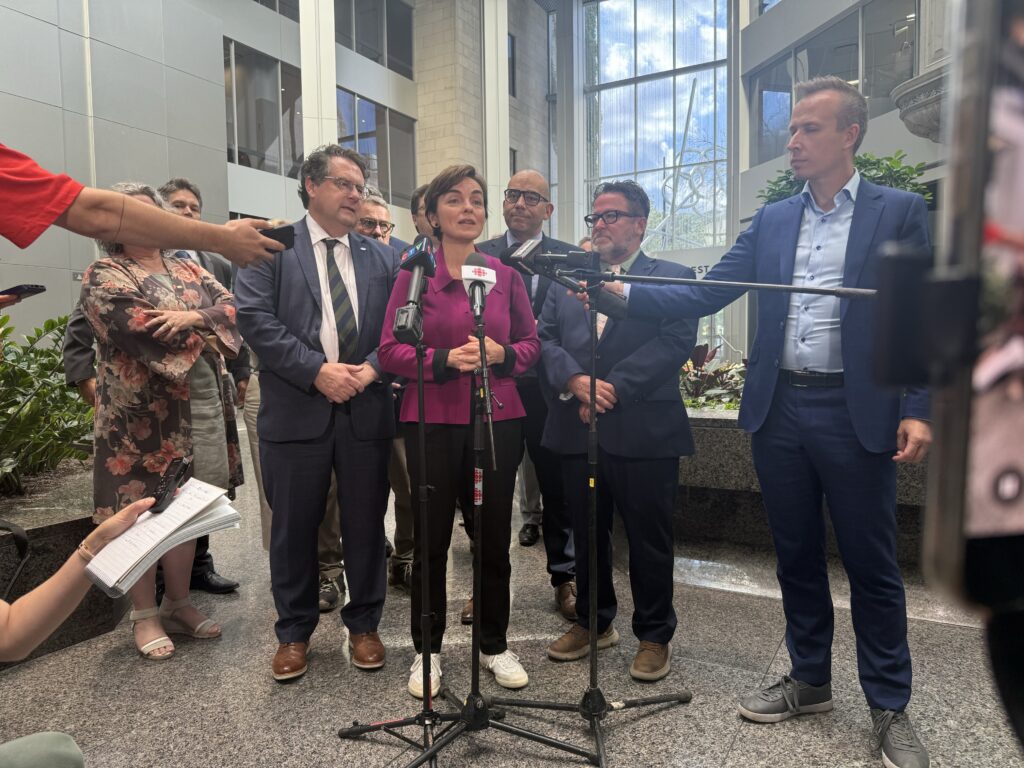
Quebec Premier Christine Fréchette met with big business owners from the province’s agricultural and food sectors Friday as the industry holds its breath for potential 50 per cent U.S. tariffs that could take effect Aug. 19.
“It’s truly a critical sector, both in terms of the number of jobs involved and for our food security and food self-sufficiency,” she said.
Fréchette said Quebec’s dairy sector could be particularly vulnerable to the tariffs. The province accounts for 37 per cent of Canada’s dairy production, with about 4,000 farms and “tens of thousands” of jobs tied to the industry.
She also pointed to the sector’s role in manufactured dairy products, saying Quebec accounts for 35 per cent of shipments.
“That’s enormous,” Fréchette said.
It was the second day of Fréchette’s emergency meeting with Quebec businesses. The premier convened with other leaders in the private sector Thursday, including the aluminum industry and representatives of the Fédération des Chambres de Commerce du Québec (FCCQ).
The committee also met with federal officials Friday as uncertainty continues over whether Canada and the United States will reach a trade agreement before the Aug. 19 deadline.
Quebec Economy Minister Bernard Drainville said there is currently “no sign” that U.S. President Donald Trump will delay the tariffs.
The looming uncertainty is also the reason why union leaders were keen to pull up a seat at the table.
FTQ President Magali Picard said workers need to be included in the province’s response to the potential tariffs. The private sector, government and labour must all collaborate if Quebec wishes to mitigate any potential damage tariffs might cause to its industries, she added.
“There needs to be a ‘Team Quebec,’” Picard said. “We are happy to be here.”
According to CSN President Caroline Senneville, organized labour must be included within trade talks because without workers, “there is no such thing as an economy.”
“If we have to trade something about forestry for the car industry, well okay, what’s in it for our workers?” she said.
The meetings come as businesses prepare for the potential fallout from the new U.S. trade measures, which could affect several Canadian industries if no deal is reached.
Fréchette said Quebec has already been among the provinces most affected by the tariff uncertainty, with thousands of jobs lost in several sectors.
Amid the choppy economic waters, the premier also sought to reassure agricultural producers that Canada will maintain its supply-management system, which regulates production and pricing for sectors including dairy, poultry and eggs.
The system provides farmers with stable incomes without relying on government subsidies.
“They are attacking our way of governance for the dairy sector,” Fréchette said. “We will maintain our own system because it is the one that works well.”
Add CityNews Montreal as a trusted source on Google to see more local stories from us.