“There was no history of breast cancer in my family, and I wasn’t unwell or hadn’t even found a lump,” she says.
Instead, O’Connell had a rash around her collarbone and at the top of her left breast, which first appeared in June 2011. She initially thought it was a heat rash — she’d just come back from a cycle and noticed it while showering.
Over the next few months, the rash came and went. O’Connell says she was not concerned: “I was never going to go to the doctor, and that’s the truth of it.”
She was treating the rash with Sudocrem, but it was “ruining her clothes”, so she asked at her local pharmacy for a different cream. The pharmacist recommended that she see her doctor about the growing rash.
O’Connell, a stay-at-home mum of three young children at the time, didn’t attend the doctor until a few weeks later, when she happened to be taking her youngest in for a check-up.
The doctor referred her to the breast care unit in the Limerick Regional Hospital, where the consultant recommended that she get a mammogram. She was sent home to await news of the appointment.
“I wasn’t concerned one bit. I felt absolutely fine. I was busy with kids and the usual coming up to Christmas.”
But on the second week in January 2012, she noticed a change. She developed flaky skin close to the nipple on her left breast. “I thought it was dry skin, so I started to put a bit of moisturiser around it.”
The flaking worsened, however, and soon the original rash merged with the dry skin area around her nipple, and it became “raw and quite sore”.
Soon after, O’Connell says her nipple “looked like it was cut, and a pus-type liquid appeared”.
She recalls that even though her nipple was sore, she didn’t know at that stage that a sore nipple or discharge from the nipple were symptoms of breast cancer.
On March 9, 2012, O’Connell was back in the breast care unit. She had a mammogram and an ultrasound of both breasts, followed by a biopsy of her left breast.
Directly afterwards, she met with her consultant, who told her she had breast cancer. “I had a substantial tumour in my left armpit, a 5.6cm tumour on one side of my breast and a 3.2cm tumour on the other side. I had a series of scans and tests over the following week, and the results came back and showed that I had stage three, grade three, HER2-positive breast cancer, which is known as an aggressive form of breast cancer.”
O’Connell found it hard to accept the diagnosis. “I kept asking, ‘Where did this come from? Why did I get this? Why me?’ I was really upset and really cross. It took me a good while to accept it.”
Telling her elderly parents and her young children was the hardest part, she recalls. “I was trying to protect everyone and be brave.”
As part of her treatment plan, O’Connell was put on the drug Herceptin, which specifically targets HER2-positive breast cancer, and she was included in a clinical trial of a new drug targeting advanced or metastatic HER2-positive breast cancer called Lapatinib. She also had to undergo a programme of chemotherapy. “The aim was to reduce the size of my tumours as they were quite big”.
The chemotherapy was tough on O’Connell. “I was hospitalised after every chemo session; I’d have chemo on a Friday and be in hospital by Sunday morning, kept in for 24 to 48 hours on a drip because I was so unwell.
“I hadn’t realised how sick I would be, and I’m so grateful for friends and neighbours dropping in dinners and minding the kids when I couldn’t.”
When she finished her chemotherapy, O’Connell had six weeks to recover before undergoing surgery to remove her left breast and 17 lymph nodes. Tests of the removed tissue and nodes signalled good news.
“It was a phenomenal result for me. There was no cancer found in the breast they removed or in the lymph nodes.”
It took eight weeks to recover from the surgery, and then she started on a course of radiotherapy to remove “any small stray cancer cells that may have been in the area”.
After 35 rounds of radiotherapy, O’Connell remained on Herceptin for a further 12 months. While she wasn’t sick during the radiotherapy or on the Herceptin, both made her feel “incredibly tired”.
Six months after finishing treatment, she underwent reconstruction surgery.
Breast cancer, says O’Connell, is not an easy thing to go through. “Speaking about it even now, I can remember distinctly everything I went through.”
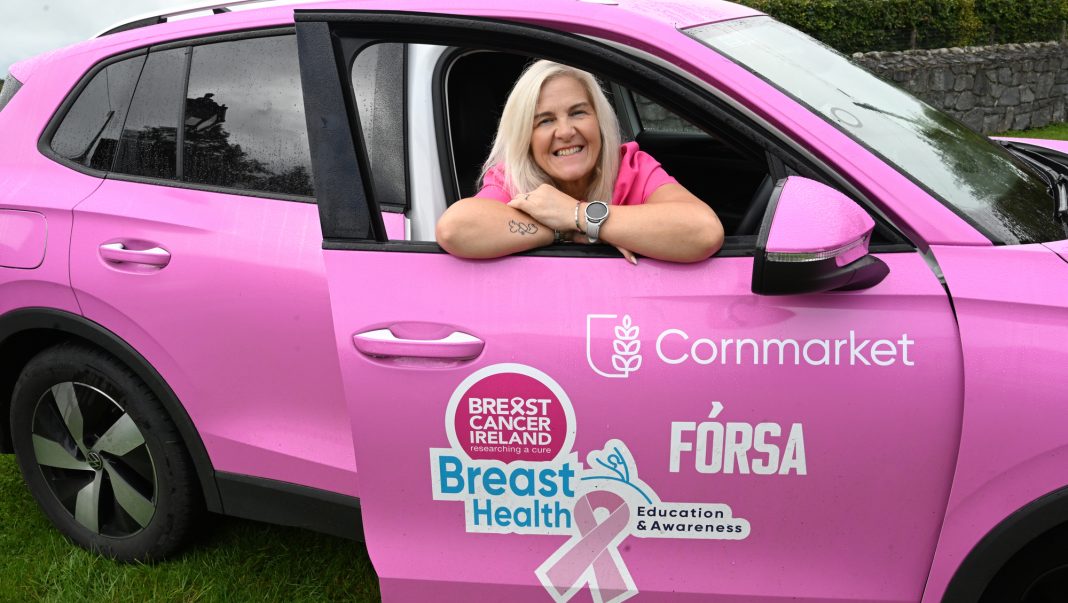
The 56-year-old Limerick woman now works for Breast Cancer Ireland as an outreach co-ordinator. She travels around the country talking about the early signs of breast cancer and advising people how to be “more breast aware”.
“I’ve built up a huge community through my job with Breast Cancer Ireland. I work full-time there — 40 hours a week — covering all of Ireland and trying to educate people. As of today, I can say that 19 people’s lives have been saved because of my presentation.”
She stresses the importance of checking our breasts. “We have over 3,700 cases diagnosed here annually. We had 40 males diagnosed with breast cancer here last year; that figure has gone up — it used to be one in 1,000 men, now it’s one in 738 men.
“Checking ourselves is something that people need to make a routine. It will take you a maximum of 15 minutes — everybody should have time every month to do it.”
The eight most common early warning signs of breast cancer are:
- Puckering, pulling, or indentation of the breast skin;
- A lump in the breast or armpit — any size, shape, or texture;
- Changes in the skin around the nipple, or nipple discharge (bloody or clear);
- Dimpling/nipple retraction, or textured “orange peel” skin;
- A sudden inversion of the nipple
- An unusual increase in the size of one breast, or an area that’s red or inflamed;
- Enlargement of the glands, or one breast sitting unusually lower than the other (nipples out of line);
- An unusual swelling in the armpit;
O’Connell highlights additional signs such as a rash, a boil, or a spot anywhere on the breast or chest that isn’t going away, and ongoing pain in the breast, chest, armpit, shoulder, or back “that doesn’t respond to painkillers or anti-inflammatories”.
If you develop any of these signs, O’Connell advises visiting your GP to get checked.
- Breast Cancer Ireland provides a free app called Breast Aware that helps people to track their breast health and guides them through monthly breast self-examinations